

The best AI web scraping tools in 2025 include ScrapingAPI.ai for reliable API-based extraction with built-in proxy rotation, Firecrawl for LLM-ready markdown output, Crawl4AI as a free open-source option, Bright Data for enterprise-scale operations, and Diffbot for AI-powered structured data. Each tool suits different budgets, team sizes, and data volumes — and we've tested them all to help you choose.
What Are AI Web Scraping Tools and How Do They Work?
AI web scraping tools use machine learning, natural language processing, and computer vision to extract data from websites automatically. Unlike traditional scrapers that follow rigid CSS selectors and XPath rules, AI-powered tools adapt when sites change their layout, handle JavaScript-rendered content, and bypass anti-bot protections without constant manual updates.

According to Future Market Insights, the AI-driven web scraping market reached $7.48 billion in 2025 and is projected to grow at 19.93% CAGR through 2034. This growth reflects a fundamental shift: 65% of enterprises now use web scraping to feed AI and machine learning projects, up from under 40% in 2022.
The core advantage is maintenance reduction. Traditional scrapers break whenever a target site updates its HTML structure — which happens frequently. AI scrapers cut maintenance overhead by 40-60% through self-healing algorithms that recognize content patterns rather than relying on exact element paths. In our experience running thousands of scraping jobs monthly at ScrapingAPI.ai, this adaptive approach means fewer failed jobs and more consistent data quality.
Which AI Web Scraping Tools Lead the Market in 2025?
Seven tools stand out across different categories — from API-first services to open-source libraries to enterprise platforms. Here's how they compare on the features that matter most.
| Tool | Type | AI Features | Best For | Starting Price |
|---|---|---|---|---|
| ScrapingAPI.ai | API Service | Auto proxy rotation, CAPTCHA solving, JS rendering | Developers needing reliable extraction | $29/month |
| Firecrawl | API Service | LLM-ready markdown output, auto-crawl | AI/LLM data pipelines | $16/month |
| Crawl4AI | Open Source | LLM extraction, chunking strategies | Python developers, budget-conscious teams | Free |
| Bright Data | Enterprise Platform | AI unblocker, 72M+ proxy IPs, scraping browser | Large-scale enterprise operations | $499/month |
| Diffbot | AI Platform | Computer vision extraction, Knowledge Graph | Structured data and entity recognition | $299/month |
| Oxylabs | API + Proxies | OxyCopilot AI assistant, ML-powered parsing | Mid-market teams with mixed needs | $49/month |
| ScrapeStorm | Desktop App | Visual AI, no-code point-and-click | Non-technical users | $49.99/month |
ScrapingAPI.ai — Built for Developer Reliability
ScrapingAPI.ai handles the hard parts of web scraping through a single API call. Send a URL, get back clean HTML or JSON. The service manages proxy rotation across millions of residential and datacenter IPs, solves CAPTCHAs automatically, and renders JavaScript-heavy pages — all without you managing any infrastructure.

We've seen success rates above 99% across e-commerce sites, search engines, and social media platforms. The REST API integrates in minutes with Python, Node.js, or any language that can make HTTP requests. For teams that need to scrape websites for LLM training, ScrapingAPI.ai's structured output format saves significant post-processing time.
Firecrawl — Purpose-Built for AI Pipelines
Firecrawl converts any website into LLM-ready markdown or structured data with a single API call. It handles JavaScript rendering, follows links for full-site crawls, and outputs clean markdown that you can feed directly into language models without additional parsing.
Since launching in 2024, Firecrawl has become the default choice for teams building RAG (Retrieval-Augmented Generation) systems. Its crawl mode follows internal links automatically, building complete site maps and extracting content from every page. The free tier gives 500 credits per month — enough for testing, but production workloads typically need the $16/month Hobby plan or higher.
Crawl4AI — The Open-Source Alternative
Crawl4AI is a free, open-source Python library that brings AI-powered extraction to developers who want full control over their scraping pipeline. It supports multiple LLM providers for intelligent content extraction, offers built-in chunking strategies for RAG applications, and handles JavaScript rendering through an integrated browser engine.
The trade-off is clear: you get maximum flexibility and zero cost, but you're responsible for managing proxies, handling rate limits, and scaling your infrastructure. For teams already comfortable with Python and Docker, Crawl4AI can match paid tools on extraction quality. We covered this tool in depth in our guide to scraping websites for LLM training.
Bright Data — Enterprise Scale
Bright Data is the go-to platform for organizations scraping millions of pages daily. Its proxy network spans over 72 million IPs across 195 countries, making it nearly impossible for target sites to block. The AI Web Unblocker automatically handles CAPTCHAs, browser fingerprinting, and anti-bot systems.
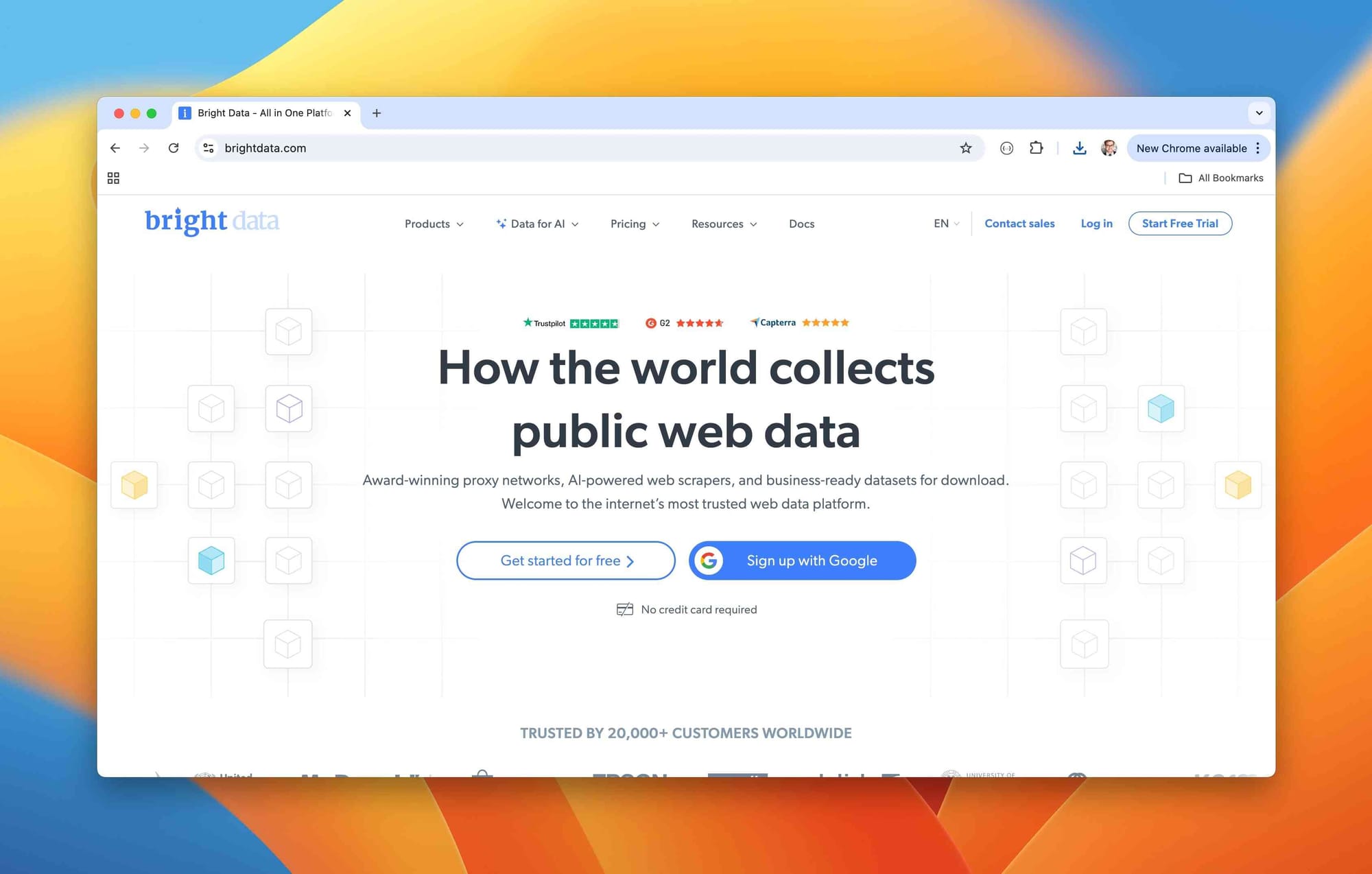
The complexity and price point match the capability. Monthly plans start at $499 for 510K records, and the learning curve is steeper than API-first alternatives. For a deeper comparison of alternatives, see our Bright Data alternatives guide.
Diffbot — AI Vision for Structured Data
Diffbot takes a fundamentally different approach: it uses computer vision to "see" web pages the way humans do, extracting structured data without relying on HTML parsing at all. Its Knowledge Graph contains over 2 billion entities, connecting scraped data to real-world context.
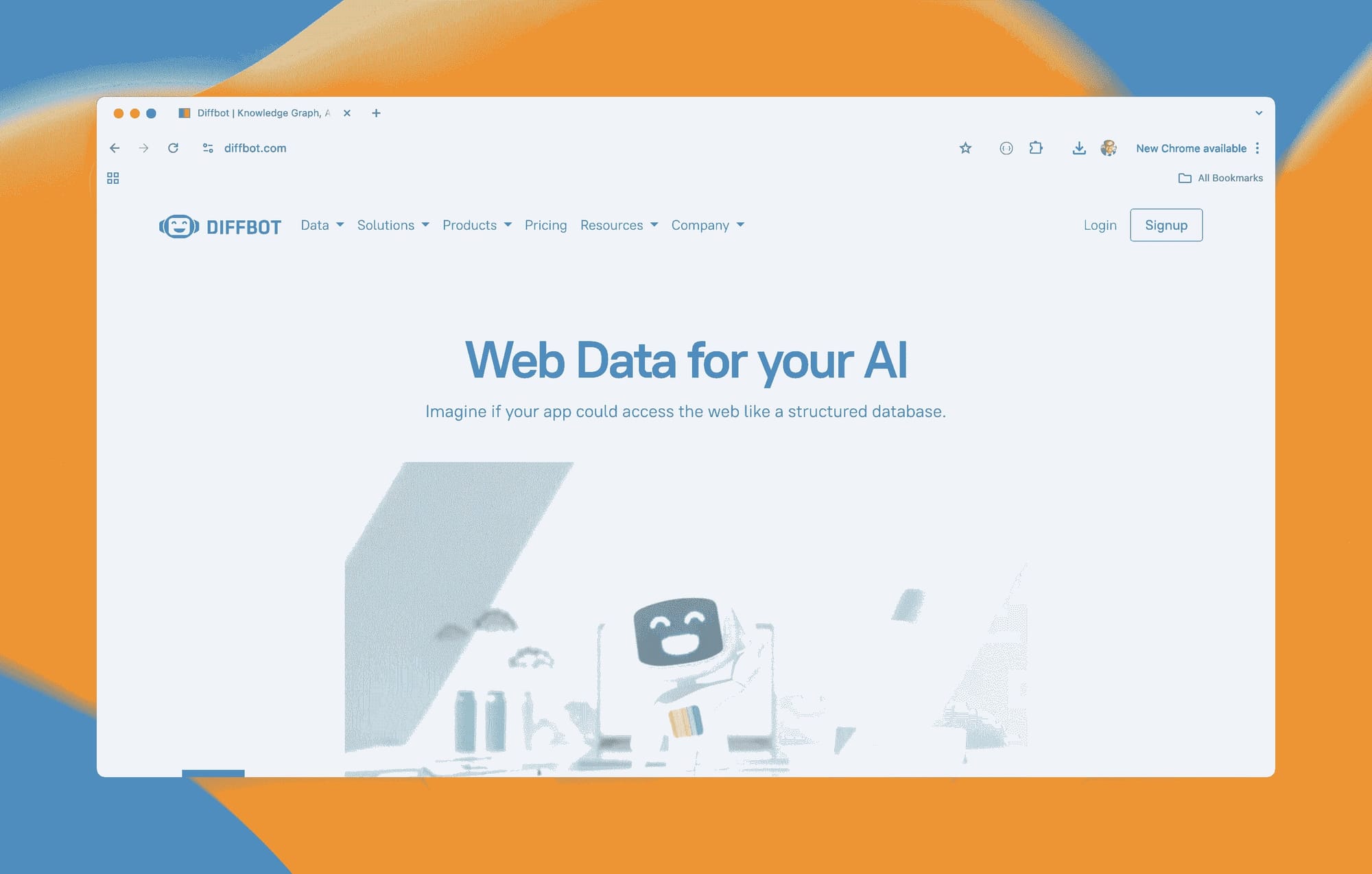
This approach excels when you need entity recognition, relationship mapping, or structured product data from inconsistent page layouts. Diffbot's Natural Language API can extract people, organizations, articles, and products automatically. The downside: pricing starts at $299/month, and the platform is overkill for simple page scraping tasks.
Oxylabs — The Mid-Market Choice
Oxylabs combines a scraping API with a large proxy network and AI-powered parsing. Its OxyCopilot feature lets you describe what you want to scrape in plain English and generates the extraction configuration automatically. According to Oxylabs' benchmarks, their Web Scraper API achieves 99%+ success rates across most target sites.
Plans start at $49/month for 17,500 results, scaling to enterprise tiers with custom pricing. It's a solid middle ground between developer-focused APIs and full enterprise platforms.
ScrapeStorm — No-Code for Non-Developers
ScrapeStorm uses visual AI to let non-technical users build scrapers by pointing and clicking. The tool auto-detects data patterns on any page and creates extraction rules without writing code. It runs on desktop (Windows, Mac, Linux) and supports scheduled scraping with data export to CSV, Excel, and databases.
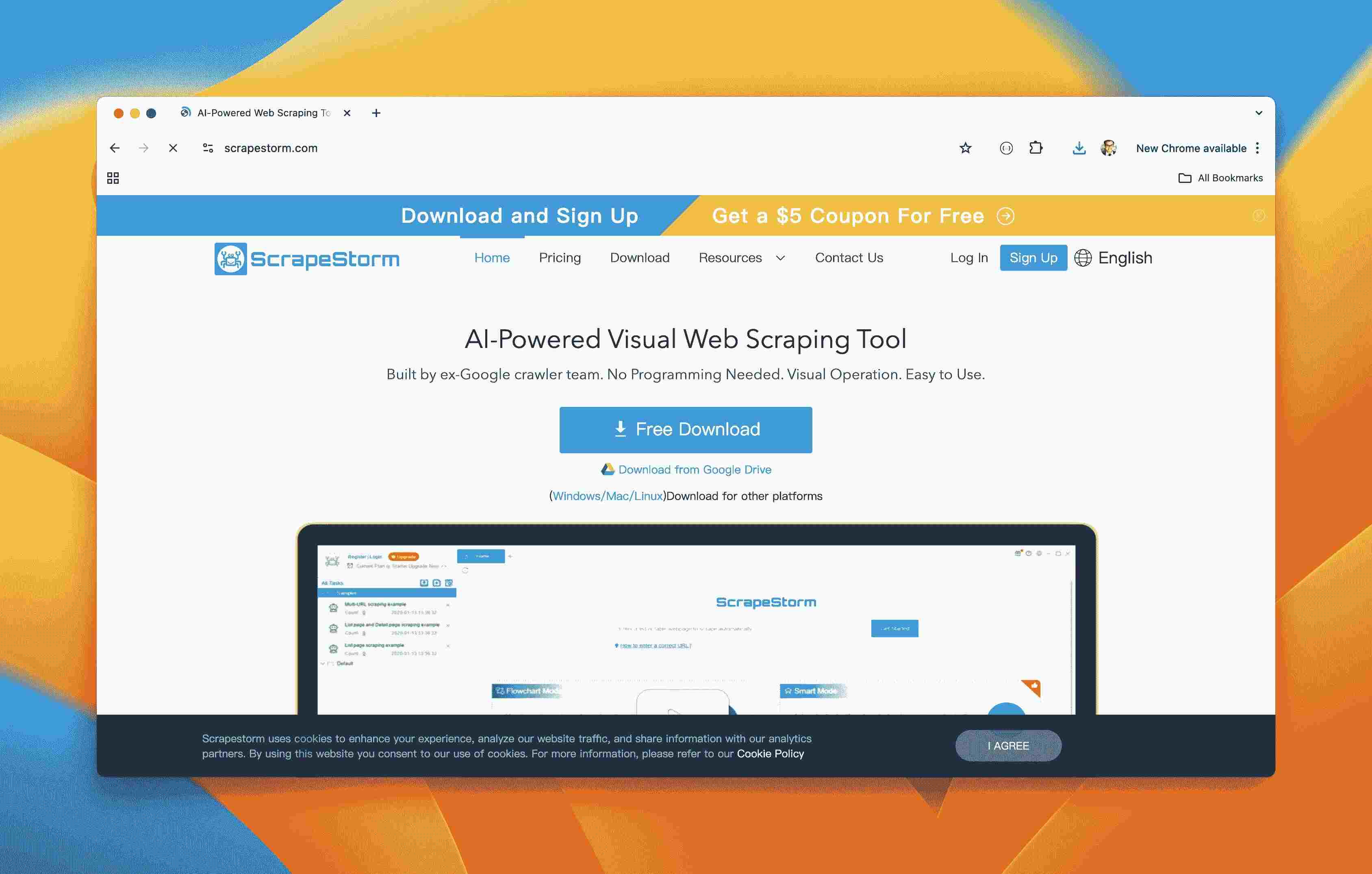
ScrapeStorm fits marketing teams, researchers, and analysts who need data extraction without engineering support. The limitation is scale — desktop-based scraping can't match cloud APIs for throughput or reliability.
How Do These Tools Compare on Pricing?
Pricing models vary significantly across AI scraping tools. Some charge per API credit, others per record extracted, and open-source options are free but require your own infrastructure. Here's a side-by-side breakdown for typical monthly usage.
| Tool | Free Tier | Starter Plan | Mid Tier | Enterprise | Pricing Model |
|---|---|---|---|---|---|
| ScrapingAPI.ai | 100 free credits | $29/mo (10K credits) | $99/mo (100K credits) | Custom | Per API credit |
| Firecrawl | 500 credits/mo | $16/mo (3K credits) | $83/mo (100K credits) | Custom | Per credit |
| Crawl4AI | Unlimited (self-hosted) | Free | Free | Free | Open source |
| Bright Data | None | $499/mo (510K records) | $999/mo (1M records) | Custom | Per record |
| Diffbot | 14-day trial | $299/mo | $899/mo | Custom | Per API call |
| Oxylabs | 1-week trial | $49/mo (17.5K results) | $249/mo (100K results) | $999+/mo | Per result |
| ScrapeStorm | Limited free | $49.99/mo | $99.99/mo | $399.99/mo | Flat rate + limits |
The right choice depends on your volume. For under 100K pages per month, API-based tools like ScrapingAPI.ai or Firecrawl offer the best value. For millions of pages, Bright Data's per-record pricing becomes more cost-effective despite the high base price. And if you have Python developers on your team, Crawl4AI costs nothing beyond your server bills.
What AI Capabilities Set These Tools Apart?
Not all "AI" in web scraping is equal. Some tools use machine learning for proxy rotation optimization, others use LLMs for content extraction, and a few use computer vision for page understanding. Here's what each tool actually does with AI.
| AI Capability | ScrapingAPI.ai | Firecrawl | Crawl4AI | Bright Data | Diffbot | Oxylabs |
|---|---|---|---|---|---|---|
| Self-healing scrapers | Yes | Yes | Partial | Yes | Yes | Yes |
| CAPTCHA solving | Built-in | No | No | Built-in | No | Built-in |
| LLM extraction | No | Yes | Yes | No | No | No |
| Computer vision | No | No | No | No | Yes | No |
| NLP/entity recognition | No | Partial | Yes | No | Yes | Partial |
| Smart proxy rotation | ML-optimized | No | No | ML-optimized | No | ML-optimized |
| Auto JS rendering | Yes | Yes | Yes | Yes | Yes | Yes |
According to PromptCloud's 2025 State of Web Scraping report, AI-powered scrapers achieve accuracy rates up to 99.5% on JavaScript-heavy sites and deliver 30-40% faster extraction compared to traditional methods. The biggest practical benefit is maintenance reduction: AI scrapers cut upkeep time by 40-60% through automatic adaptation to site changes.
What Features Should You Evaluate When Choosing a Tool?
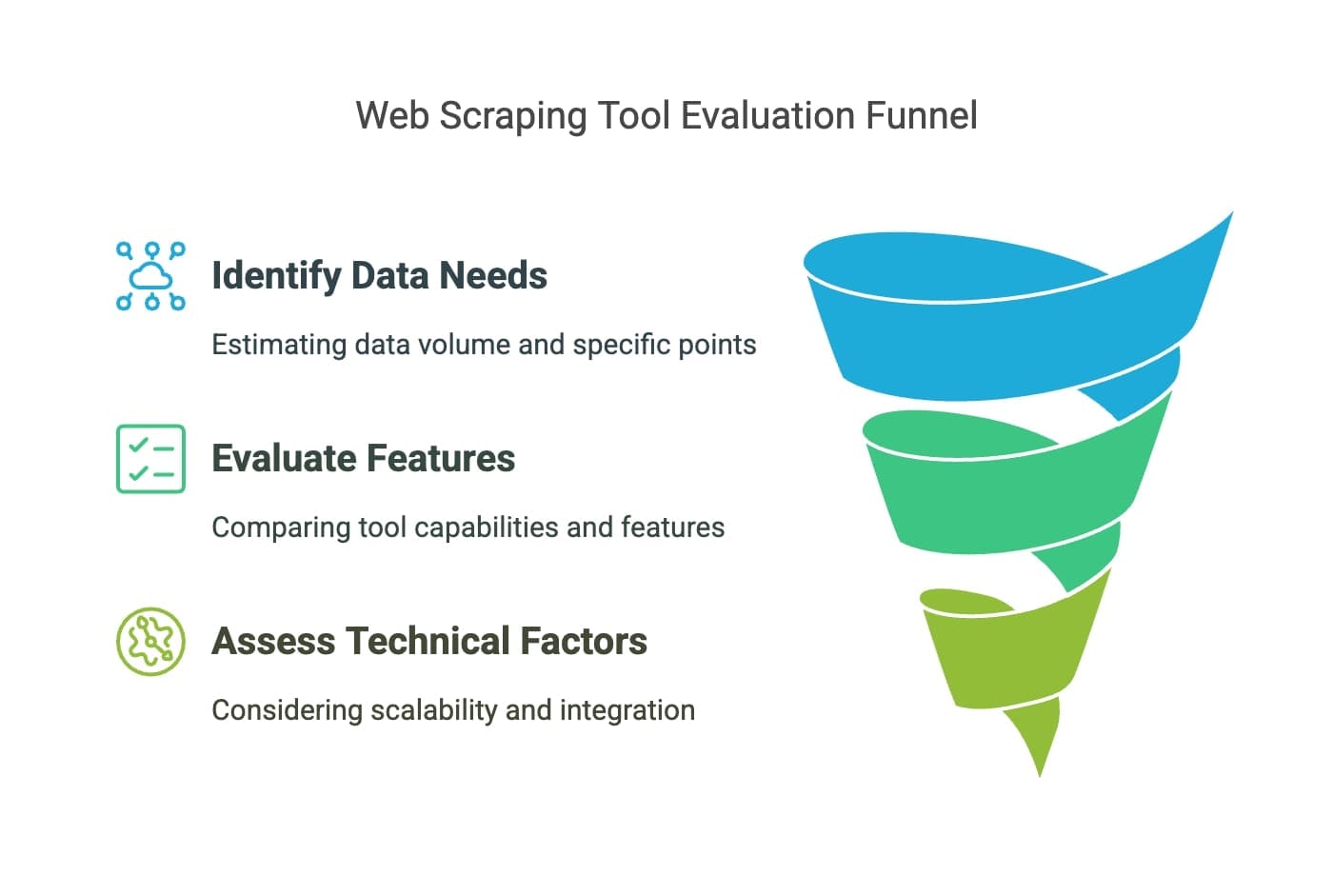
Picking the right tool comes down to five factors: your data volume, technical team size, target site complexity, budget, and how you'll use the extracted data. Here's a decision framework we use when advising ScrapingAPI.ai customers.
| Use Case | Best Tool | Why |
|---|---|---|
| Quick API integration for developers | ScrapingAPI.ai | Single API call, handles proxies/CAPTCHAs/JS automatically |
| Building LLM/RAG applications | Firecrawl or Crawl4AI | Native markdown output, built-in chunking for vector databases |
| Enterprise-scale price monitoring | Bright Data | 72M+ IPs, handles anti-bot systems at massive scale |
| Structured product data extraction | Diffbot | Computer vision understands page layout without CSS selectors |
| Non-technical team needs data | ScrapeStorm | Visual point-and-click, no coding required |
| Budget-conscious Python teams | Crawl4AI | Free, open-source, full control over pipeline |
| Mid-market balanced needs | Oxylabs | Good proxy network + AI parsing at moderate price |
Before committing to any tool, run a pilot project. Most paid tools offer free tiers or trials. Test against your actual target sites — success rates vary dramatically depending on the site's anti-bot protections. A tool that works perfectly on Amazon might struggle with a heavily protected airline booking site, and vice versa.
For more on evaluating scraping APIs specifically, see our best web scraping API comparison.
How Are Businesses Using AI Web Scraping in Practice?
AI web scraping has moved well beyond simple data collection. According to ScrapingDog's 2026 industry analysis, 81% of US retailers now use automated price scraping for dynamic repricing — up from 34% in 2020. Here are the most common real-world applications we see across ScrapingAPI.ai's customer base.
E-commerce price monitoring remains the top use case. Retailers scrape competitor prices across hundreds of sites, feeding data into repricing algorithms that adjust prices in near real-time. One mid-size e-commerce client tracked over 100,000 products daily and saw a 40% improvement in pricing optimization within three months.
The second-fastest growing use case is AI training data collection. With major platforms restricting API access (Reddit, Twitter/X, Stack Overflow all raised prices or limited free tiers since 2023), teams building LLMs and fine-tuning models increasingly rely on web scraping. Our analysis of AI in web scraping found that 65% of enterprises now scrape web data specifically for ML projects.
Market research automation saves teams 85% of manual data collection time. Instead of analysts manually visiting competitor sites, AI scrapers monitor 50+ sources continuously, extracting product launches, pricing changes, customer reviews, and social media mentions. According to Kanhasoft's industry research, 67% of US investment advisors now use alternative data sourced through web scraping.
Lead generation and sales intelligence is another major application. B2B companies scrape business directories, LinkedIn profiles (within terms of service), and industry databases to build prospect lists enriched with company data, technology stacks, and recent news mentions.
What Are the Legal and Ethical Guidelines for AI Scraping?
Web scraping is legal in most jurisdictions, but specific practices can cross legal lines. The key precedent is the 2022 US Supreme Court ruling in Van Buren v. United States, which narrowed the Computer Fraud and Abuse Act's scope. The hiQ Labs v. LinkedIn decision further established that scraping publicly available data doesn't violate federal law.
That said, responsible scraping practices aren't just about avoiding lawsuits — they protect your infrastructure too. For a complete guide, see our ethical web scraping guide and our analysis of legal battles that changed web scraping.
Best practices we follow:
- Respect robots.txt directives and crawl-delay headers
- Rate-limit requests to avoid overloading target servers
- Don't scrape personal data without a lawful basis under GDPR/CCPA
- Check and comply with each site's Terms of Service
- Store extracted data securely with appropriate access controls
- Use scraped data only for the purpose you collected it for
Anti-bot systems are also getting more sophisticated. For sites with aggressive CAPTCHA protection, see our guide on how to bypass CAPTCHA with AI and our CAPTCHA wars statistics.
What Trends Will Shape AI Web Scraping in 2026 and Beyond?
Three trends are reshaping the industry right now, and they'll accelerate through 2026.
LLM-native scraping is replacing rule-based extraction. Instead of writing CSS selectors, you describe what data you want in natural language and the scraper figures out how to get it. Firecrawl and Crawl4AI already support this pattern, and enterprise tools are adding similar capabilities. According to Mordor Intelligence, the web scraping market will reach $2 billion by 2030, driven largely by AI integration.
Cloud-native scraping is now dominant. 68% of all scraping workloads run in the cloud, growing at 17.2% annually. The shift from desktop tools and self-hosted scrapers to cloud APIs means faster deployment, better scaling, and lower maintenance — exactly the model that ScrapingAPI.ai and similar services provide.
Stricter compliance frameworks are emerging. The EU AI Act, updated GDPR enforcement, and platform-specific restrictions are pushing teams toward verified, permission-based crawling. Tools that build compliance features directly into their scraping pipeline — rate limiting, robots.txt adherence, data minimization — will have a significant advantage over raw scraping libraries.
The AI-driven web scraping market is projected to reach $38.44 billion by 2034, representing a 19.93% CAGR from 2025. For businesses that depend on web data, investing in the right AI scraping tool isn't optional anymore — it's infrastructure.


